

As published in the Abiquiú News
in 2025
See what is blooming in Abiquiú in
April,
May,
June,
July,
August,
September and
October
Browse by color:
Pink,
White,
Blue/Purple,
Yellow/Green,
Red/Orange
September 26, 2025
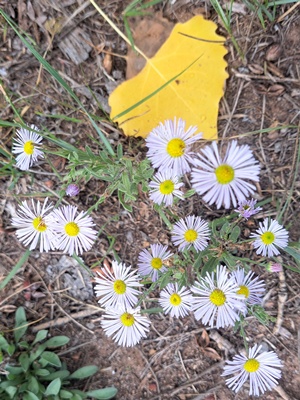
Spreading Daisy
Spreading Fleabane
Erigeron divergens
Sunflower Family (Asteraceae)
Found in a variety of habitats, disturbed areas
Seen blooming in September in Abiquiu
September is the time for asters to bloom; White, Golden and Purple Asters are abundant. There is also a similar looking daisy blooming right now. Spreading Daisy blooms from spring through the fall. It grows low, spreading and hairy to 18 inches in dense clusters with many branches growing from a single stem. Short leaves on the stems grow upwards. The ¾ inch flowers are white to lavender with numerous narrow rays. Traditionally, it has a variety of medicinal uses; as a snuff for headaches, to aid childbirth, as an eyewash, as a lotion for ‘lightning infection’, and for snake bites. It was used as a good luck charm by the Kiowa people. Source.
September 19, 2025
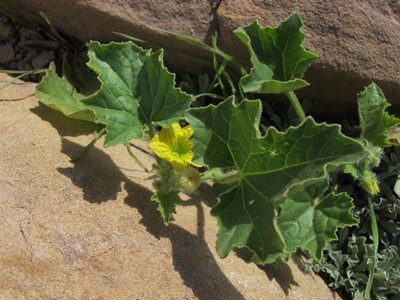
Melon Loco
Apodanthera undulata
Gourd Family (Cucurbitaceae)
Found in dry sand and gravel
Seen blooming in September at Abiquiu Lake
Melon Loco is a foul-smelling, grayish, hairy creeper growing to 10 feet long with rounded, lobed, wavy-edged, hairy leaves that feel like sandpaper. The showy flowers are yellow and funnel-shaped. The mature melons are green and have raised ridges running lengthwise. The melons taste so bad you would have to be loco to eat one. Source.
September 12, 2025
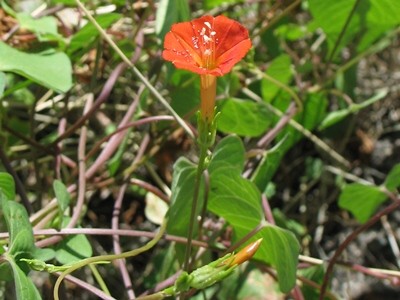
Star-Glory
Trans-Pecos Morning Glory
Red Morning Glory
Scarlet Creeper
Trompillo
Ipomoea cristulata
Morning Glory Family (Convolvulaceae)
Found in disturbed areas, waste places
Seen blooming in September in Ohkay Owingeh
A twisting, twining vine that can grow to 10 feet long but usually less. The bright red tubular flowers are about one inch long with protruding white stamens. They stay open all day to attract hummingbirds, unlike other morning glories. It is considered invasive in some regions. I could find no traditional uses of the plant but other members of the genus have been used to treat various diseases.
September 5, 2025
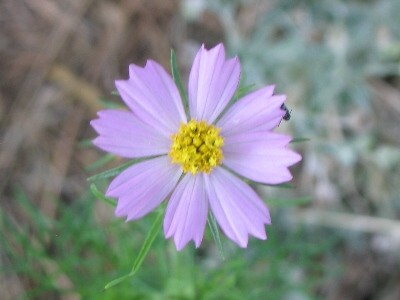
Southwestern Cosmos
Wild Cosmos
Cosmos parviflorus
Sunflower Family (Asteraceae)
Found in open pine forests, sandy, disturbed soil
Seen blooming in September on the Quemazon Trail, Los Alamos
The attractive Southwestern Cosmos grows to 2½ feet high with a slender, airy shape and thread-like leaves. The flower is about an inch across, white to rosy to violet in color with toothed petals. The seeds are barbed, causing them to lodge in fur or clothing. The Navajo used a cold infusion of the dried leaves as a ceremonial chant lotion. Source.
August 29, 2025
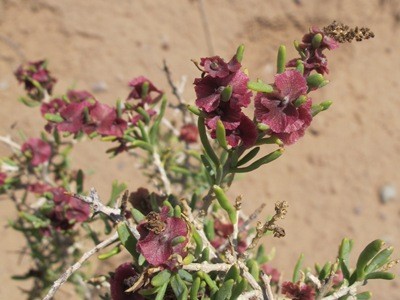
Greasewood
Black Greasewood
Sarcobatus vermiculatus
Greasewood Family (Sarcobataceae)
Found in hot, dry, open saline or alkaline areas
Seen blooming in June and fruiting in August on CR 142
Greasewood is a common shrub in our area. Scruffy looking, it is easily overlooked for most of the year. It grows from three to eight feet tall and six feet across with thorny, white branches which darken with age. Its leaves are narrow, green and fleshy. Male and female flowers are tiny and greenish on the same bush; the males in catkin-like spikes, the females in the leaf axils. They bloom in June but the flowers are inconspicuous. The photo shows the seed pods surrounded by a flower-like, papery wing that is pale green maturing to red. Greasewood is an important winter browse plant for domestic sheep, cattle, elk, mule deer, pronghorn and jackrabbits. Traditionally, sharpened sticks were used in acupuncture and to make arrow shafts. The wood is strong and was used in construction, to make clothes hooks, planting sticks and stirring rods, and for fuel in the kivas. Medicinally, the plant was used for insect bites, diarrhea and on aching and decayed teeth. The young shoots were eaten as greens and the seeds roasted and eaten during hard times. Source.
August 22, 2025
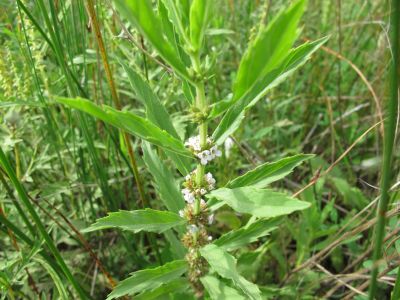
Water Horehound
American Water Horehound
American Bugleweed
Lycopus americanus
Mint Family (Lamiaceae)
Found in wet areas near slow-moving water
Seen blooming in August by the Rio Chama
Water Horehound is not a particularly showy plant. It grows up to three feet tall with the characteristic square stem of a mint, but it does not have aromatic leaves. It grows in similar habitat to Wild Mint which has lavender flowers and a distinctive aroma. The leaves are opposite and toothed. The tiny white tubular flowers with lavender markings grow in a whorl around the stem at the base of the leaves. Each flower has two stamens. Traditionally, a compound containing the entire plant was used for stomach cramps. Source. In modern times people use bugleweed for overactive thyroid (hyperthyroidism), premenstrual syndrome (PMS), insomnia, and other conditions, but there is no good scientific evidence to support these uses. Source.
August 15, 2025
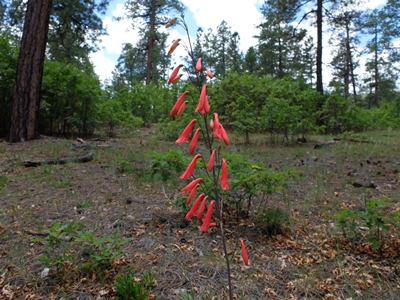
Beardlip Penstemon
Scarlet Bugler
Golden-beard Penstemon
Varita de San Jose
Penstemon barbatus
Plantain Family (Plantaginaceae)
Found in open, rocky soil in mixed conifer forests
Seen blooming in August by FS Rd 137 in Carson NF
Beardlip Penstemon has spikes of tubular flowers which are very attractive to hummingbirds. It grows to four feet tall with long, narrow, dark green leaves, mostly at the base of the plant. The flowers are 1½ inches long and have two long protruding upper lobes and three lower lobes with golden hairs in the throat. It blooms for many weeks. Native Americans had many medicinal uses for the plant. It was used for menstrual pain and stomachache, burns, coughs, gun wounds and arrow wounds, and as a diuretic. The chewed root was rubbed over the rabbit stick to ensure success in the hunt. A rabbit stick which was treated in this manner was sure to kill any rabbit that it was aimed at, provided the thrower had a good heart. Source.
August 8, 2025
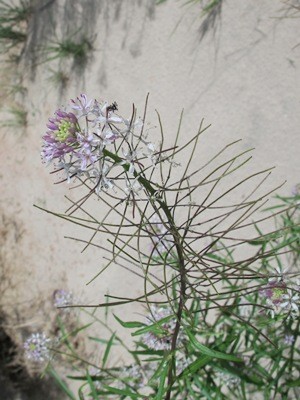
Wright's Thelypody
Thelypodium wrightii
Mustard Family (Brassicaceae)
Found on rocky hillsides, in canyons
Seen blooming in August in Plaza Blanca
Wright’s Thelypody grows to seven feet tall with many branches tipped by showy flower heads that look like bottlebrushes. Leaves have smooth or toothed edges. The flowers are white to lavender with four petals and grow in loose clusters above many 3-inch-long thin seed pods. The pods grow horizontally to the stem or curve downwards. Traditionally Wright’s Thelypody has been used as a dermatological aid and as an eye medicine. Young plants were made into a stew with wild onions, wild celery, tallow or bits of meat. The Navajo tied a plant to the cradle bow to make baby sleep and the Tewa used it to make paint for pottery. Source.
August 1, 2025
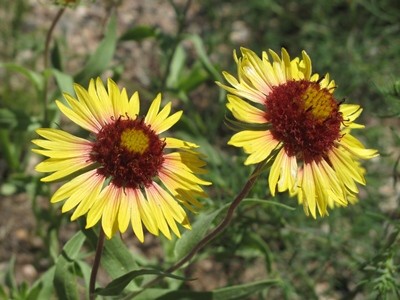
Firewheel
Indian Blanket
Gaillardia pulchella
Sunflower Family (Asteraceae)
Found in dry, open areas
Seen blooming in
late July in Abiquiu
Gaillardia seeds are often included in wildflower mixes but it is a native plant that occurs naturally in our area. Firewheel grows to two feet high with a grayish stem. Leaves are up to three inches in length, with entire or lobed edges. Flowers are two to three inches across. Flower petals are quite deeply divided into three lobes at the tip, and may be all red, all yellow, or banded, reddish near the center and yellow at the tips. The central disk is reddish-purple. Flowers can bloom from May to August. Traditionally, the plant's root has been used to create a tea for treating gastroenteritis and for creating a poultice to apply to skin conditions. Additionally, a tea made from the plant has been used to soothe sore eyes and sore nipples, especially for breastfeeding mothers. An infusion of the plant was used to become a good drummer. The Kiowa tribe also considered the plant to be a symbol of good luck and used them for ornaments in their homes. Source.
July 25, 2025
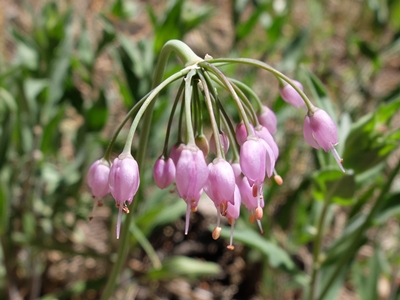
Nodding Onion
Ajo-cebolla
Allium cernuum
Amaryllis Family (Amaryllidaceae)
Found in rocky soils, slopes, woodlands
Seen blooming in July on Canada Bonita Trail, Santa Fe National Forest
Nodding Onion grows 12 to 18 inches with flat, grass-like leaves that smell of onion when cut or bruised. Tiny bell-shaped flowers droop in a cluster from a slender stem. Native American tribes used the juice of Nodding Onion to treat colds, colic, liver complaints, dropsy and hives, and a poultice of the onions was used to treat infection, sores, and swellings. Bulbs, stems, and flowers can be eaten raw or cooked in small amounts. Like chives, the flowers are an attractive and edible garnish for salads. It is said that the city of Chicago gets its name from the Algonquin Indian name for this plant, chigagou. Source.
July 18, 2025
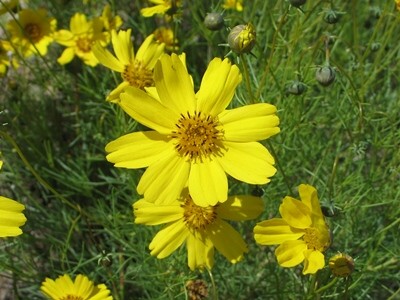
Stiff Greenthread
Showy Navajo Tea
Thelesperma filifolium
Sunflower Family (Asteraceae)
Found in rocky, sandy, disturbed areas
Seen blooming in July in Abiquiu
Stiff Greenthread grows to two feet tall with numerous thread-like leaves and single flower heads on delicate stalks. The flower buds droop and become erect when open. The flower has eight notched petals and a yellow or reddish-brown center. The flowers are popular with bees and butterflies. Indian Teas, of the Thelesperma genus, are widely used as a beverage, for treating children with tuberculosis and as a dye by Native American peoples. Source.
July 11, 2025
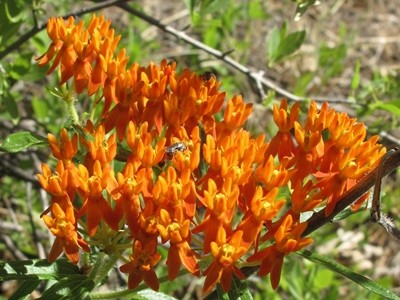
Butterfly Weed
Orange Milkweed
Pleurisy Root
Asclepias tuberosa
Dogbane Family (Apocynaceae)
Found in open areas, canyons
Seen blooming in July in Bandelier National Monument
I am not seeing many butterflies this year. Perhaps I should plant this Butterfly Weed in my yard. This vibrant flower attracts butterflies and hummingbirds with its nectar while Monarch butterfly caterpillars feed on its leaves. Not what I would call a weed. It grows from 1 to 2½ feet tall with stout, hairy stems and lance-shaped leaves. Bright orange flowers are in a flat-topped cluster two to three inches across. It has a history of medicinal use, particularly for respiratory issues. It's known for its antispasmodic, diaphoretic, and expectorant properties, making it a traditional remedy for conditions like bronchitis, pneumonia, and pleurisy. It has also been used for influenza, stomach pains, diarrhea, heart troubles, snakebites and dog or coyote bites. Source.
July 4, 2025
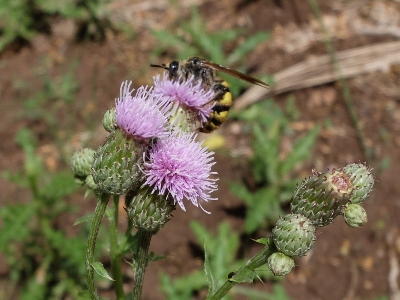
Canada Thistle
Creeping Thistle
Field Thistle
Cirsium arvense
Sunflower Family (Asteraceae)
Found in disturbed soil
Seen blooming in July by the Tierra Azul acequia
Not a wildflower to encourage, Canada Thistle is one of the most economically important agricultural weeds in the world. It was introduced to North America in the 1600s and soon was recognized as a problem weed. Weed control legislation against the species was passed by the Vermont legislature in 1795. Canada Thistle is now listed as a noxious weed in most areas where it occurs. Despite this, it can be a source of forage for livestock, providing similar nutritional value to alfalfa, bees and butterflies love it as a source of nectar. It is an aggressive plant that grows three to five feet tall in large, dense colonies from a deep and wide-spreading root system. Leaves are very spiny and lobed with wavy edges. The many flower heads are pale-purplish, ½ to ¾ inch across and less than one inch high. Bracts are pointed but do not have spines. Roots can be eaten raw or cooked, but may cause flatulence. Stems can be peeled and cooked like asparagus or rhubarb. The leaves are edible but not worth the effort of removing the spines. The root is tonic, diuretic, astringent, antiphlogistic and hepatic. It has been chewed as a remedy for toothache. A decoction of the roots was used to treat worms in children. Source.
June 27, 2025
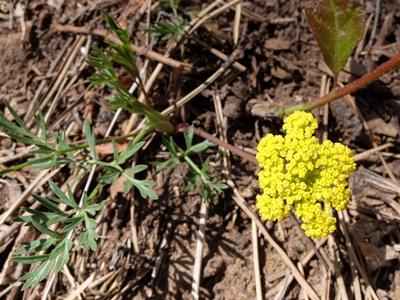
Mountain Parsley
Biscuitroot
Alpine False Spring Parsley
Pseudocymopterus montanus
Parsley Family (Apiaceae)
Found in moist meadows, woodlands
Seen blooming in June near FS Rd 137 in Carson NF
The bright yellow flowers of Mountain Parsley are a common sight on trails at higher elevations throughout the summer. It grows from a few inches high at alpine elevations to two feet with slender stem and basal leaves that have long stalks and narrow leaf segments. The flowers grow in a flat, umbrella-like cluster of tiny flowers up to two inches wide. Flowers can be red, orange or purple in color but I have only seen yellow ones. The entire plant is edible, with the root being a significant source of sustenance. The dried root was ground into a flour which gave it the common name of Biscuitroot. Leaves were eaten as a green, the root was cooked with meat, and the leaves were boiled with cornmeal. Native Americans used it for gastrointestinal and urinary issues, as a laxative, and for ceremonial purposes. Additionally, the Navajo took an infusion or decoction after swallowing an ant. Source.
June 20, 2025
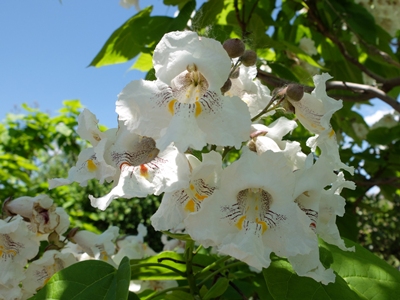
Northern Catalpa
Cigar-tree
Hardy Catalpa
Western Catalpa
Indian Bean
Catalpa speciosa
Bignonia Family (Bignoniaceae)
Found in roadsides, clearings, yards
Seen blooming in June near Hwy 554
Northern Catalpa is native to the mid-West but it has been widely planted in urban areas as a street tree and lawn tree as it grows in moist low spots or dry areas with poor soils. The name ‘catalpa’ comes from the Cherokee Indian name for the tree. It grows 40 to 60 feet tall, with a narrow, open, irregularly rounded crown and spreading branches. Its bark is brownish-gray becoming ridged with age. It has large, heart-shaped leaves and pyramid-shaped clusters of fragrant, showy flowers. Flowers are large, over 2 inches long, white and bell-shaped with ruffled edges and orange stripes and purple spots and stripes inside. The long, bean-like seed pods are 8 to 18 inches long, turn brown and persist through the winter. European settlers planted the tree to produce fence posts. Railroad companies grew plantations of it for use as track ties and fuel wood. Carpenters commonly used it for interior trim and to make furniture. The seed pods are not toxic but have no culinary use. Pioneer doctors used the seed pods and seeds to make a decoction for chronic bronchial infections, spasmodic asthma, labored breathing and heart problems. The juice from either the leaves or roots was used to treat swelling of an eye or cutaneous affections. Green leaves were crushed and placed on swollen lymph glands. Source.
June 13, 2025
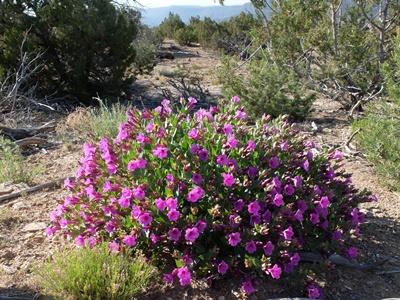
Showy Four O’clock
Colorado Four O’clock
Wild Four O’clock
Mirabilis multiflora
Four O’clock Family (Nyctaginaceae)
Found in sandy, disturbed areas, roadsides, under old junipers
Seen blooming in June by FS Road 23, Carson NF
Showy Four O'clock is a magnificent native wildflower that blooms all summer and into the fall. The Latin name, Mirabilis multiflora, translates to "marvelous multi-flowered plant", which is a fitting description. Stems spread to two feet tall and six feet across forming a mound of soft, heart-shaped leaves and flowers. Magenta-pink flowers are funnel-like, up to three inches long, opening in the evening for pollination by hawkmoths, and closing the next morning, unless it is cloudy. Showy Four O'clock has become a popular xeriscape plant in southwestern gardens. It requires little supplemental water once established and needs plenty of space or it will smother adjacent plants. Native Americans used the root in the treatment of stomach complaints; to relieve hunger and after overeating to relieve the discomfort. It was used as an antiseptic to wash out wounds in horses and a poultice of the powdered root applied to swellings. Source.
June 6, 2025
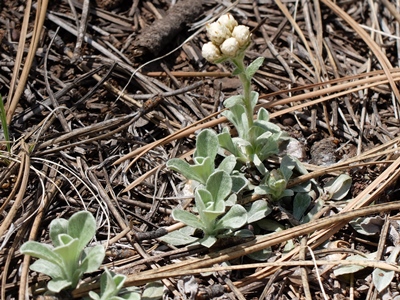
Small-leaf Pussytoes
Sunloving Pussytoes
Catsfoot
Antennaria parvifolia
Sunflower Family (Asteraceae)
Found in dry meadows, slopes, dry coniferous forests
Seen blooming in late May by FS Rd 137, Carson NF
The flower heads of the Antennaria genus grow in a tightly packed cluster which, from above, resemble a cat's paw, from below, so it was given the common name of Pussytoes. Small-leaf Pussytoes grows to four inches high, usually less, from a mat of small, grey-green leaves. Flower heads of two to seven flowers appear when stems are only two inches high. Traditionally it was used to treat swellings, chewed with deer or sheep tallow as a blood purifier, taken for the mad coyote bite, a cold infusion of the root was taken as protection against witches, and the young leaves were used as greens. Source.
May 30, 2025

Navajo Fleabane
Hairy Daisy
Shaggy Fleabane
Erigeron concinnus
Sunflower Family (Asteraceae)
Found in dry, sandy areas
Seen blooming in May in Plaza Blanca
One of the many daisies blooming in our area at the moment, the Navajo Fleabane grows to 10 inches high; this was about 6 inches. It is covered in fine hairs that give the plant a fuzzy appearance. Leaves are narrow. Flower buds are nodding but become erect at flowering. Flowers are white to pale lavender. An infusion of the plant was used by the Navajo for general body pain, headaches, gonorrhea, difficult labor and ‘antelope infection’. Source.
May 23, 2025

Whitestem Blazingstar
Rama Pegajosa
Small-flowered Blazingstar
Mentzelia albicaulis
Stickleaf Family (Loasaceae)
Found in dry, sandy areas
Seen blooming in May by CR 142, Abiquiu
The Stickleaf family is so named because their leaves have barbed hairs that stick to clothing and fur like Velcro. The Whitestem Blazingstar starts blooming as soon as it is just out of the ground, as shown in the photo, until it reaches its maximum height of six to twelve inches. The stem is pale in color, maturing to white, growing from a distinctive basal rosette of rough, deeply lobed leaves. The overall plant is more dainty, less bushy and less commonly seen than other members of the family. Flowers have five yellow petals which are orange at the center and are barely ½ inch across. The flower heads are often nodding. Several Native American tribes used the seeds for food, grinding them into a flour or butter. The Hopi smoked the plant as a substitute for tobacco and used it for a toothache remedy. The Navajo made a compound of the leaves for snakebites. Source.
May 16, 2025

Oregon Grape
Holly Grape
Creeping Barberry
Berberis (Mahonia) repens
Barberry Family (Berberidaceae)
Found on rocky slopes, in woodlands
Seen blooming in May on the north rim of Canon de Cobre
Oregon Grape is a shrub growing low to the ground with holly-like leaves which turn red in the fall. Clusters of small yellow flowers are followed by blue-black grape-like fruit which is edible. They are used for making jams, jellies, etc. They can also be made into a refreshing lemonade-like beverage. When sugar is added, the fruit juice is similar to grape juice. Oregon grape has a variety of medicinal uses, primarily stemming from the berberine compound found in its roots and bark. It was used by Native Americans to treat loss of appetite and to prevent bloody dysentery. Its current herbal use is mainly in the treatment of gastritis and general digestive weakness, to stimulate the kidney and gallbladder function and to reduce catarrhal problems. It is taken internally in the treatment of psoriasis, syphilis, hemorrhages and impure blood conditions. Externally, it has been used as a gargle for sore throats and as a wash for blurry or bloodshot eyes. The fruit is an excellent gentle and safe laxative. A bright yellow dye is obtained from the inner bark of the stem and roots, violet and dark blue-purple dyes are obtained from the fruit. Source.
May 9, 2025

Painted Milkvetch
Astragalus ceramicus
Pea Family (Fabaceae)
Found on dry, sandy areas
Seen blooming in May by CR 142
Painted Milkvetch is another of the many Astragalus species that grow in our area, identified by their seed pod rather than their flower or leaves. It is easily overlooked because it is so small and grows sprawling over the ground only a few inches high with narrow, folded, hairy, gray-green leaflets. The flowers are pink to purple and about ¼ inch long. The seed pods are inflated, mottled red and an inch long. The botanist who named it thought the pattern on the pods was ceramic-like. Traditionally, the Hopi dug up the sweet roots and gave them to children as candy. Source.
May 2, 2025

Stemless Townsend Daisy
Stemless Townsendia
Easter Daisy
Townsendia exscapa
Sunflower Family (Asteraceae)
Found on dry, sandy, gravelly slopes
Seen blooming in May in Plaza Blanca
Several species of Townsend Daisy can be found growing in our area. They are sometimes called Easter Daisies because they bloom around Easter time. Stemless Townsend Daisies grow in a low growing clump with slightly hairy, narrow, grayish leaves. Flowers are white to pinkish and one inch across often with a darker pink stripe on the back. The flowers grow directly from the root without a stem, hence its common name. Traditionally, the Blackfoot tribe gave a decoction of roots to tired horses to relieve them while the Navajo chewed or took an infusion of the plant to ease delivery, and used it to unravel ceremonial knots. Source.
April 25, 2025

Turkey Peas
Small-flowered Milkvetch
Astragalus nuttallianus
Pea Family (Fabaceae)
Found in sandy openings
Seen blooming in April in Plaza Blanca
Turkey Peas stems grow from two to ten inches sprawling in a mat or erect. Stems are reddish and hairy. Leaves are on long stems and have 7-15 hairy leaflets. Tiny flowers, about 1/4 inch wide, have purple banners with a white center. Seed pods are red and slightly curved, about ½ inch long. No edible or medicinal uses were found on the internet, nor the reason for the common name Turkey Peas. A Google search found five other plants with the common name of Turkey Peas, multiple recipes using turkey and peas, and dog food.
April 18, 2025

Spiny Blue Bowls
Desert Blue Gilia
Bluebowls
Giliastrum acerosum
Phlox Family (Polemoniaceae)
Found in dry, open, gravelly areas
Seen blooming in April in Poshuouinge, Santa Fe NF
Although it grows only three to six inches tall Spiny Blue Bowls are noticeable because of their deep blue flowers. Flowers are ½ inch across with a bright yellow center. Leaves are needle-like and stems woody. Native Americans massaged the crushed plant on cramping muscles. Source.
April 11, 2025

Newberry’s Milkvetch
Astragalus newberryi
Pea Family (Fabaceae)
Found in dry, sandy areas
Seen blooming in April on Chimney Rock Trail at Ghost Ranch
This beautiful little plant grows low to the ground with 5 to 11 silky leaflets. Flowers are showy, bright pink/purple with a lighter center and are over one inch long. Seed pods are curved and covered in silky, white hairs. Traditional uses for Newberry’s Milkvetch are unknown, but other Milkvetch species have uses. The plant is considered poisonous, especially to stock and horses, however medicinally; a decoction of the whole plant was used as a wash for the head, hair and whole body, for stomach disorders, as a gargle for sore throats, a poultice of crushed leaves applied to a lame back, applied as an ointment for animals with urination troubles, roots were chewed as a cathartic, an infusion of root was used as a wash for sores and as a wash for granulated eyelids and toothaches, also plants were used as a ceremonial emetic, the seeds used for food, and pounded seeds mixed with other foods and used as a spice. Source.
April 4, 2025

Tawny Cat’s Eye
Tawny Cryptantha
Gray Cat’s Eye
Cryptantha fulvocanescens
Borage Family (Boraginaceae)
Found in dry, sandy, gravelly areas
Seen blooming in April in Red Wash Canyon
The Borage family are low growing, densely hairy plants and have flowers with five petals. Cryptanthas are distinguished by their tiny white clusters of flowers with a yellow center, the “eye”. They are commonly known as Cat’s Eyes. Plants will often show last year’s dried stems and leaves. This one grows to about six inches high in clumps. Native Americans, specifically the Navajo, used Tawny Cat’s Eye for medicinal purposes: a decoction of plants was taken at childbirth, a cold infusion was used to treat snakebites, a poultice applied for toothaches and the plants were chewed for coughs and colds. Source.
To comment, please email me.