

As published in the Abiquiú News
in 2026
See what is blooming in Abiquiú in
April,
May,
June,
July,
August,
September and
October
Browse by color:
Pink,
White,
Blue/Purple,
Yellow/Green,
Red/Orange
By 2026, over 10 years, I had added 255 species of flowers and trees to the Bloom Blog. The chances of me finding many more to add were pretty slim so I would have to repeat flowers to continue publishing. I thought I might try to draw or paint the flowers but I found it was easier to use AI, Copilot, Gemini and ChatGPT, to create their images as a watercolor drawing from the original photo. Tap the image to see the photo. Use your browser to print the page.
August 21, 2026

Common Sunflower
Annual Sunflower
Girasol
Helianthus annuus
Sunflower Family (Asteraceae)
Found in disturbed soil, roadsides, open sunny areas
Seen blooming in August by CR 155
This will be the last Bloom Blog for 2026. Due to the drought and the prolonged excessive heat, it has been a really tough season for the bloomers, and most every living thing. Many plants bloomed a month early, some bloomed and fried before they could set seeds, some didn’t bloom at all. The bloomers are those that have adapted to a very dry environment with deep roots. I hope you have enjoyed AI’s interpretation of my photos. I am impressed. It was a fun project. I asked for the sunflower in the style of Van Gogh.
In our area wild sunflowers can grow to over nine feet tall, widely branching, with hairy, reddish stems. The domesticated sunflower, grown for seeds and oil, usually has a single stem topped by a much larger flower. Leaves are heart-shaped, rough and coarsely toothed with long stalks. The center of the flower is reddish-purple. Bracts under the flower are broad and oval. Traditionally, several Native American groups planted sunflowers on the north edges of their gardens as a "fourth sister" to the better known three sisters; corn, beans, and squash. They were used for food and ceremonial purposes. The Navajo used the plant for prenatal infection caused by a solar eclipse, for wart removal and on an injury from a horse falling on a person. Source. Read here about the medicinal and edible uses of the Sunflower and here for the history, culture and a fascinating discussion of the mathematical spiral arrangement of the disk flowers.
August 21, 2026

Showy Palafox
Othake
Sand Palafox
Palafoxia sphacelata
Sunflower Family (Asteraceae)
Found in sandy areas
Seen blooming in August on the Madera Trail in Santa Fe NF
Showy Palafox grows to two feet high with a slender, sticky-hairy stem with sand stuck to it so the plant disappears, except for its showy flowers. Leaves are few and narrowly lance-shaped. Flowers are an inch across and grow at the end of the branches. They have only five petals which are divided into three lobes and eventually fade to white. The name Palafox honors Juan de Palafox y Mendoza (1600-1659), founder of the University of Mexico and bishop of Puebla but another website says it is named after José de Palafox y Melzi, Duke of Saragossa (1776–1847), a Spanish captain-general in the war against the invading armies of Napoleon. Quite a different era and personality. Yo no se. No traditional uses are recorded for this plant but related Rosy Palafox was used to help with fever, nausea, and chills while Desert Palafox was used for a yellow dye. Source.
August 14, 2026

Curlycup Gumweed
Resinweed
Curlytop Gumweed
Grindelia squarrosa
Sunflower Family (Asteraceae)
Found at roadsides and in disturbed soil
Seen blooming in August by Highway 554
Gumweeds ooze a whitish, viscous, resinous fluid from their flower buds so are very recognizable. It grows to two feet high in a bushy shape with green or whitish stems. Leaves are oblong and toothed with no stalks. Also very recognizable are the five to six rows of sticky, hooked bracts around the flower head. Petals may or may not be present. Gumweeds have been used for many medicinal purposes by Native Americans, including as a wash for poison oak rashes and burns and for pulmonary troubles and to treat the liver and kidneys. The resinous sap that covers the leaves has been used as a substitute for chewing gum. Green and yellow dyes can be obtained from the yellow flowering heads and pods. Grindelias are still used for asthma and bronchitis, and in common cough remedies in homeopathic medicine. Source.
August 7, 2026

Chicory
Blue Sailors
Coffeeweed
Succory
Witloof
Endivia
Cichorium intybus
Sunflower Family (Asteraceae)
Found at roadsides and in disturbed soil
Seen blooming in August by Highway 84
This pretty blue flower is considered a noxious weed in Colorado and New Mexico because of its invasive tendencies but it is also grown as a forage crop for livestock. It can grow to five feet tall with a stout, rigid stem and mostly basal dandelion-like leaves. The flowers and small leaves grow from the stem. Flowers are more than an inch across and have squared, toothed petals. The leaves are eaten in some cultures. The roots are dried and ground and used as a coffee substitute or as an additive to beer. Cultivated varieties of chicory include Belgian endive and radicchio. Medicinally it is used to eliminate intestinal parasites and as a tonic. Source.
July 31, 2026
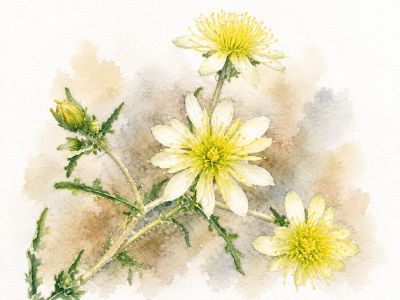
Adonis Blazingstar
Desert Blazing Star
Stickleaf
Pegapega
Buena Mujer
Mentzelia multiflora
Stickleaf Family(Loasaceae)
Found at roadsides and in dry, sandy areas
Seen blooming in July by Hwy 554
Blazingstars are also called Eveningstars because they do not open until late in the afternoon, making photography a challenge: this photo was taken at 7.09 pm. During the day their flowers are tightly closed so easily overlooked. They are in the Stickleaf family, so named because their leaves have barbed hairs and a highly viscous sap which will glom onto animal fur, socks or clothing of anything or anyone coming into close contact with it. Spanish-New Mexicans called it pegapega, which clearly defines the plant’s strength. Translated into English, pegapega means, “it sticks, it sticks”. It grows to 2 ½ feet tall with stout white branched stems. Flowers are one to two inches across with long yellow stamens. They can be bright yellow but I mostly see pale yellow, almost white flowers in this area. The seeds have been eaten raw or ground into a meal. Medicinally it has been used to treat tuberculosis, as a diuretic, a laxative and as a pain reliever for rheumatism and toothaches. Tewa Indians had one of the most interesting uses for the Blazingstar. When a young boy was old enough to ride a horse for the first time, the Tewa would rub the leaves of the plant over the boy’s skin before he mounted the horse. The sticky plant substance was used to help with the boy’s grip and enable him to ride without falling off. Source.
July 24, 2026
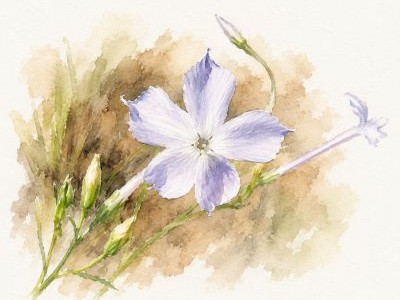
Flaxflowered Gilia
Pale Trumpets
Blue Gilia
Starflower
Longflowered Skyrocket
Ipomopsis longiflora
Phlox Family (Polemoniaceae)
Found in open, sandy areas
Seen blooming in July by Arroyo Trujillo
This delicate plant grows to 18 inches with many branches, slender grey-green leaves and stems. Flowers are white, light blue or lavender with a floral tube up to 3 inches long. It blooms from spring to fall depending on the rains, as so many do. Native Americans used Flaxflowered Gilia to treat a variety of ailments. The leaves were boiled with the resulting liquid taken for stomachaches; crushed leaves and flowers were steeped into a tea that was taken for headaches, used on sores, and served as a hair tonic to prevent baldness and lengthen the hair; and the plant was chewed together with salt to treat heartburn. An infusion of the flowers was mixed with feed and given to sheep with stomach disorders. The Zuni people use the dried, powdered flowers to create a poultice to remove hair on newborns and children. Source.
July 17, 2026
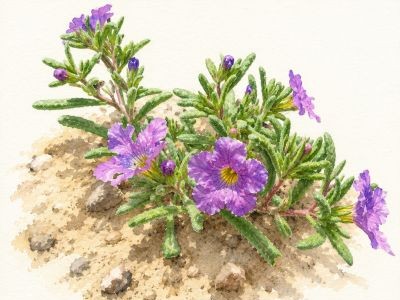
Bristly Nama
Sandbells
Nama hispidum
Four O’clock Family (Nyctaginaceae)
Found in sandy areas
Seen blooming in July by Hwy 554
When the rainfall is good, this ground-hugging annual can blanket the earth with purple, but in dry seasons like this year, it may have only a single blossom, almost as large as the rest of the plant. It grows from 2 to 8 inches high with very hairy leaves and stems. Flowers can be pinkish to violet-purple in color. They are ½ inch across and have a white-ringed yellow throat. The Navajo use the plant as a lotion for spider or tarantula bites. Source.
July 10, 2026
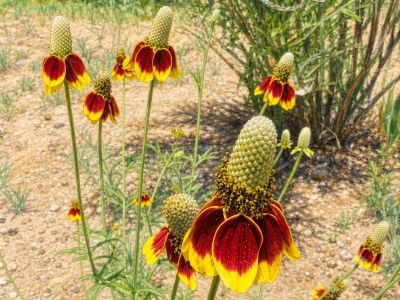
Mexican Hat
Prairie Coneflower
Ratibida columnifera
Sunflower Family (Asteraceae)
Found on dry slopes, by roadsides
Seen blooming in July near Hwy 554
Mexican Hat grows from one to three feet tall with narrow, deeply divided leaves. The flower-head is a purplish-green cylindrical cone up to 2½ inches high skirted by drooping, usually yellow, sometimes reddish, petals. It is native but is grown as an ornamental so can escape back into the wild. A pleasant tasting tea is made from the leaves and flower head. The plant has medicinal properties that are pain-relieving and fever-reducing. The Cheyenne used tea as a wash to relieve pain and to treat poison ivy rash, and also as a wash to draw the poison out of rattlesnake bites. The Sicangu people in South Dakota used a tea of plant tops for headaches and stomachaches. The Acoma and Laguna Indians used crushed leaves rubbed on a mother’s breast to wean a child while the Lakota used the plant top as a nipple. The Navajo gave a cold infusion to sheep which are 'out of their minds.' Source.
July 3, 2026
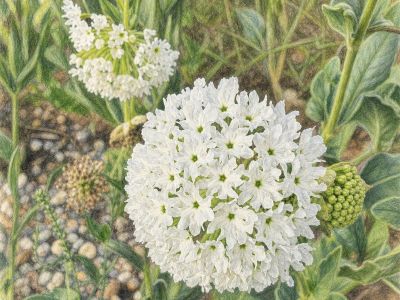
Snowball Sand Verbena
Prairie Snowball
Fragrant Verbena
Sand Verbena
Abronia fragrans
Four O’clock Family (Nyctaginaceae)
Found in dry, sandy soil
Seen blooming in late June by Hwy 554
Snowball Sand Verbena grows upright and sprawling to three feet with sticky, hairy stems and fleshy, opposite leaves. The funnel-shaped flowers are fragrant and usually white but can be pinkish. They grow in a ball shaped cluster over two inches across. The flowers open in the late afternoon and close again in the morning, a habit which gives the Nyctaginaceae family its common name of Four O'clock. It has a wide range of uses. Among the Navajo, it is used for boils and taken internally when a spider is swallowed. The Kayenta Navajo use it as a cathartic, for insect bites, as a sudorific, as an emetic, for stomach cramps, and as a general panacea. The Ramah Navajo use it as a lotion for sores or sore mouth and to bathe perspiring feet. The Keres, Acoma and Laguna mix ground roots with cornmeal and eat it to gain weight. The Keres also use this mixture to keep from becoming greedy and make ceremonial necklaces from the plant. The Utes use roots and flowers for stomach and bowel troubles, whereas the Zuni use the fresh flowers alone for stomach aches. Source.
June 26, 2026
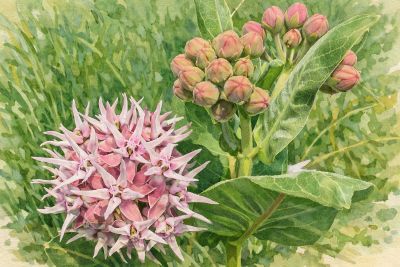
Showy Milkweed, Talayote
Asclepias speciosa
Dogbane Family (Apocynaceae)
Found in moist, disturbed soil, roadsides
Seen blooming in June by Tierra Azul Acequia
Showy Milkweed is very important to the Monarch butterfly. Plants serve as a host for their eggs and the caterpillars which eat only milkweed. Other butterflies, moths and hummingbirds also enjoy their nectar. Showy Milkweed grows two to five feet tall with large, thick leaves in pairs on a stout stem. Leaves and stems produce a milky sap when broken. The star-shaped flowers are ¾ inch across and grow in a cluster several inches across. A 2 to 4 inch seed pod is produced filled with seeds, each with long silky hairs. Traditionally, the roots, seeds, young plants and flower buds were eaten and all parts of the plant used for different medicinal purposes; as an eye medicine; for stomachache, for warts, venereal diseases, as an emetic, externally for rheumatism, for skin sores, for coughs, for drawing poison from snakebites, for tuberculosis, for diarrhea, and as an antiseptic. The dried, hardened milk was used for chewing gum. The seed silk was used to stuff pillows and woven into cloth and the seeds strung together to make necklaces. Source.
June 19, 2026
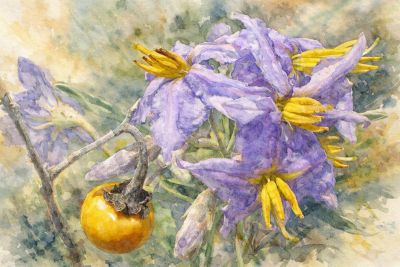
Silverleaf Nightshade
Silver Nightshade
Trompillo
Silverleaf Nettle
White Horsenettle
Solanum elaeagnifolium
Nightshade Family (Solanaceae)
Found in disturbed areas, roadsides
Seen blooming in June by Hwy 554
The Nightshade family includes tomatoes, potatoes, tomatillos and eggplant, medicinal plants and spices. While some members of the family are edible, others are highly toxic. Silverleaf Nightshade grows from one to three feet tall with stiff prickly hairs on the stem. Leaves have wavy edges and are hairy which gives them a silvery gray appearance. The flowers have five purplish petals united to form a star and five protruding yellow stamens. The plant produces a yellow tomato-like berry which is poisonous to livestock and humans. It is considered a noxious weed in some states but not in New Mexico. The Pima Indians used the berries to curdle milk in making cheese, and the Kiowa used the seeds together with brain tissue to tan leather. The chewed root was applied to snake bites and placed in a tooth cavity to ease the pain. Source.
June 12, 2026
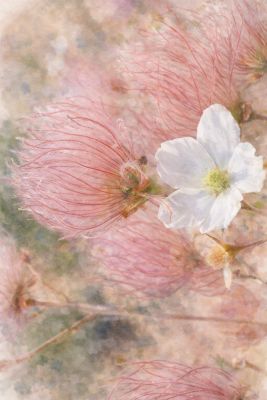
Apache Plume
Ponil
Fallugia paradoxa
Rose Family (Rosaceae)
Found on dry mesas, in washes and on exposed slopes
Seen blooming in June in Red Wash Canyon
How are you liking these images generated by AI? I think they are quite lovely. When CoPilot creates the image, it also creates a description. I simply asked it to create a watercolor from the photo. This one is quite poetic.
Watercolor Rendering of Your White Flower and Pink Seedheads
The painting centers the five‑petaled white flower, its petals rendered in soft, translucent washes. Each petal carries a whisper of cool blue shadow near the base, giving it that luminous, paper‑thin quality desert flowers have in morning light. The yellow‑green stamens sit like a tiny sunburst at the center.
Surrounding it, the feathery pink seedheads explode outward in airy halos. I painted them with long, wet‑on‑dry strokes so the filaments stay crisp, then softened the outer edges with a clean-water brush to let them dissolve into the background. The pink shifts from deep rose at the base to a pale blush at the tips.
The background is a loose, warm wash — sandy ochre, sage green, and a touch of violet — just enough to hint at the desert floor without pulling attention from the delicate structures.
The whole piece feels light, breathy, and full of motion, like a single breeze could lift the seedheads right off the page.
This is my description of Apache Plume - A native shrub growing to six feet tall and several feet wide with tangled, whitish twigs and small, deeply divided leaves. Flowers are rose-like with five white petals and are about one inch across. They produce plumes of feathery pink seeds which are said to resemble an Apache war bonnet. It is planted as an ornamental and for erosion control. It is an important forage plant for wild animals. Hopis steeped the leaves and applied the liquid as a rinse to promote hair growth. Roots dug in fall were boiled in water for coughs, spring twigs made into tea for indigestion and spring fever. Slender branches were bound and used for sweeping, to make cradleboards and arrows. Source.
June 5, 2026
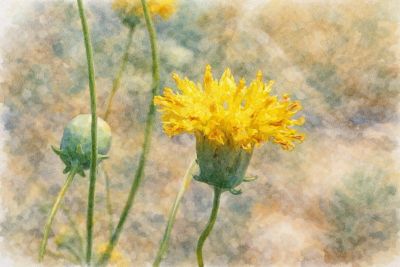
Cota
Hopi Tea
Indian Tea
Zuni Tea
Rayless Greenthread
Thelesperma megapotamicum
Sunflower Family (Asteraceae)
Found in sunny, sandy, dry areas, roadsides
Seen blooming in June by CR 162
Cota, abundant in the Abiquiu area, grows to 2 ½ feet with smooth, wiry stems. It is also known as Greenthread for its narrow, threadlike, divided green leaves. Thelesperma have two rows of bracts; the inner one fused together, the outer ones stick out at 90 degrees. There are no ray flowers, only disk flowers. Native American peoples used Indian Teas, of the Thelesperma genus, as a beverage, for children with tuberculosis, as a toothache remedy, and as a dye. Source.
May 29, 2026
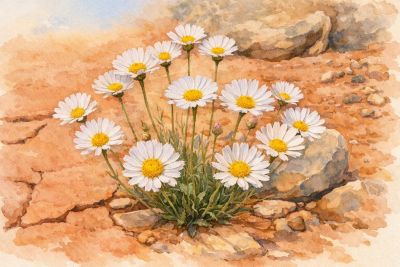
Basin Fleabane
Basin Daisy
Beautiful Daisy
Erigeron pulcherrimus
Sunflower Family (Asteraceae)
Found in dry, silty areas, piñon-juniper
Seen blooming in May in Red Wash Canyon
Pulcherrimus means extremely beautiful and this daisy is certainly that. It grows in dense clumps to 12 inches high with narrow, mostly basal leaves. There is only one flowerhead on a stem. Flowers are one inch across with a yellow disk and curling petals which can be white to pale lavender. Daisies are also called Fleabanes. Some early American settlers kept dried fleabane in their homes and in small satchels to repel gnats and fleas, which is how the plant got its common name. In fact, there is no evidence that supports fleabane as an insect repellent. Source.
May 22, 2026
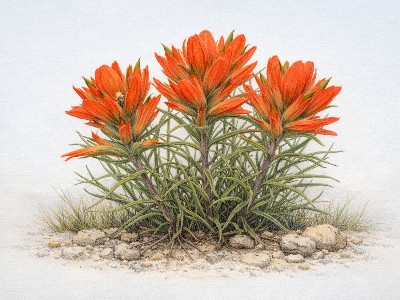
Orange Paintbrush
Wholeleaf Paintbrush
Foothills Paintbrush
Castilleja integra
Broomrape Family (Orobanchaceae)
Found in piñon-juniper and Ponderosa woodlands
Seen blooming in May in Small Fry Prospect
This is one of several species of Indian Paintbrush that grow in our area. Orange Paintbrush can grow to 20 inches tall, typically less, with long, purplish-green, rolled leaves and hairy stems. What appears to be flowers, the paintbrush, are actually modified leaves, bracts. The flowers are a narrow, greenish tube protruding beyond the bracts. The flower heads are red to orange to salmon. Native Americans found different uses for the plant; root bark was used with minerals to color deer skin black, dried bracts were mixed with chile seeds to prevent spoilage during storage, the plant was held by women for decoration during the harvest dance, a poultice of leaves was used to dress burns, a decoction of the leaf was taken during pregnancy to keep the baby small, for easy labor. Source. Read more about the Legend and Uses of Indian Paintbrush.
May 15, 2026
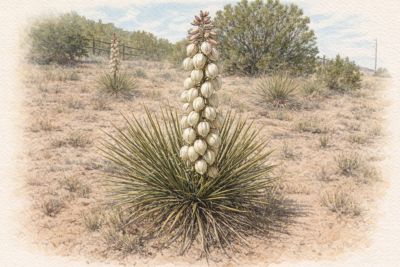
Navajo Yucca
Bailey’s Narrow Leaf Yucca
Alpine Yucca
Lewis Flax
Yucca baileyi
Asparagus Family (Asparagaceae)
Found in dry woodlands, openings
Seen blooming in May in Poshuouinge, Santa Fe NF
Navajo Yucca is an evergreen shrub growing as a rosette of narrow, sharp-pointed, yellowish-green leaves with fibrous edges. The flower stem grows two to three feet tall. The large, waxy flowers grow in a long, drooping cluster. Flowers can be eaten raw or cooked, and can also be dried, crushed and used as a flavoring. The flower stem can be peeled, cooked and used like asparagus. A fiber obtained from the leaves is used for making ropes, baskets and mats. The leaves themselves can be used as paint brushes, brooms or woven to make mats. The roots are rich in saponins and can be used as a soap substitute. The Navajo people make extensive use of the yucca to make a wide assortment of useful and ceremonial items. Source.
May 8, 2026
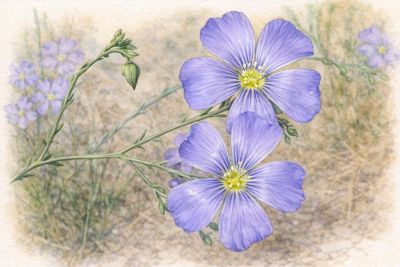
Blue Flax, Wild Flax
Prairie Flax
Lewis Flax
Linum lewisii
Flax Family (Linaceae)
Found in dry meadows, slopes
Seen blooming in May in Abiquiu
Blue Flax grows to over two feet tall with wiry, slender stems branching out from the base. It often can be found growing in large patches. Leaves are small and grayish-green. Flowers are one inch across and open in the morning for just one day. Color varies from pale blue to almost purple with a silky sheen. Native Americans consumed the seeds for their flavor and nutrients. A tea made from the stems and leaves was used to treat various medical problems such as eye infections, stomach disorders, and swellings. Livestock exhibits a state of drowsiness when feeding on Blue Flax. Blue Flax was used to make strong rope. Today a cultivated flax is still grown for its "linen" fiber and "linseed oil". Source.
May 1, 2026
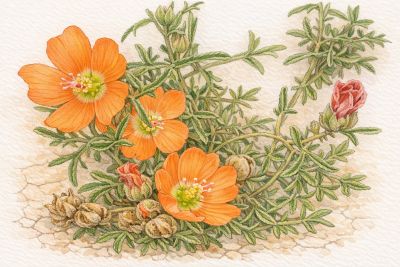
Cowboy’s Delight
Scarlet Globemallow
Copper Mallow
Sphaeralcea coccinea
Mallow Family (Malvaceae)
Found in dry slopes, disturbed soil
Seen blooming in April in Plaza Blanca
This is one of six species of Globemallow that grow in our area and is the earliest bloomer. Scarlet Globemallow grows from 4 to 16 inches tall in large patches, usually about 8 inches high. Leaves are deeply divided into three or five then divided again and can appear grayish-green from the fine silvery hairs that cover them. Sometimes the edges fold in making them appear even narrower. Flowers grow in a dense cluster at the end of the branches and have five orange petals forming a cup or saucer shape. The fruit produced is shaped like a cheese-wheel and splits apart into segments like an orange. Its common name of Cowboy’s Delight is said to come from the delight its bright colors gave to a cowboy in a dull, arid landscape. The Teton Sioux used it ceremonially. A paste was used as a cooling agent for burns, scalds, and sores. A tea was used as a lotion for skin diseases, and a tonic to improve appetite. The Navajo used a tea for improving the taste of bitter medicinal herbs. Crushed leaves were used as a poultice for skin irritations and as a shoe liner for blistered feet. Source.
April 24, 2026
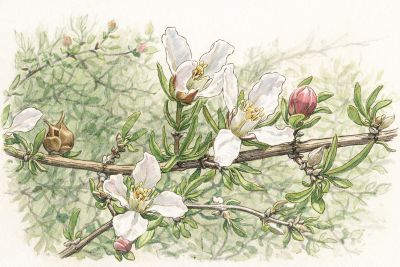
Cliff Fendlerbush
False Mock-orange
Fendlera rupicola
Hydrangea Family (Hydrangeaceae)
Found on dry, rocky slopes
Seen blooming in April in Red Wash Canyon
Cliff Fendlerbush is a many-branched shrub growing in a columnar shape from 3 to 10 feet tall with tough, dark stems. The leaves are narrow and thick. In spring, the branch tips are covered with a profusion of pink buds which mature into brilliant white fragrant flowers. Flowers have four petals which narrow to the center. It was used by early Native Americans to kill lice and taken after accidentally swallowing ants. It was also used to make arrows, forks, planting sticks, knitting needles and to make ceremonial items and in ceremonial medicine. Source.
April 17, 2026
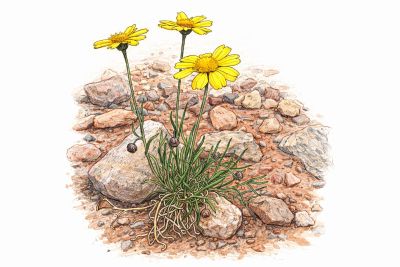
Perky Sue, Ives' Four-nerved Daisy
Tetraneuris ivesiana
Sunflower Family (Asteraceae)
Found in open sandy areas, roadsides
Seen blooming in April in Red Wash Canyon
Four-nerved Daisy, or Perky Sue, is distinguished by the petal tips which have three notches. There are several varieties. This one is quite common in our area and grows to 10 inches with mostly basal, tightly clustered, narrow leaves pointing upwards. Stems and bracts under the flower are hairy but the leaves are not, unlike other species. See more Perky Sues in Wildflowers of the Southern Rocky Mountains. No traditional uses were found but related species were used medicinally for heartburn and in lotion for eczema, for 'coyote infection', for dreaming of being bitten by an 'alligator', and in a special ceremony for illness caused by a lunar eclipse. Source.
April 10, 2026
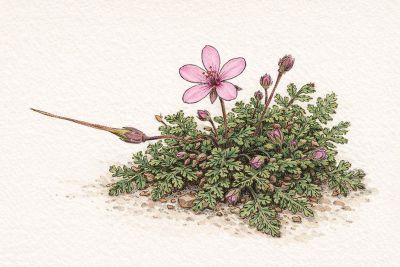
Redstem Filaree
Heron's Bill
Storksbill
Alfilerillo
Erodium cicutarium
Geranium Family (Geraniaceae)
Found in bare, sandy, disturbed areas
Seen blooming in late March by Abiquiu Lake
Filaree grows to three inches high with creeping, reddish, hairy stems. The flower is less than ½ inch across. Finely divided leaves grow in a rosette and are grayish-green. The fruit resembles a stork's bill and is about one inch long. When ripe the seed pod bursts open in a spiral, sending the seeds (which have little feathery parachutes attached) into the air. The entire plant is edible with a flavor similar to sharp parsley, if picked young. Traditionally a leaf tea has been used to induce sweating and is diuretic. The leaves were also soaked in bath water to treat rheumatism. It has been used for uterine and other bleeding, roots and leaves were eaten by nursing mothers to increase milk flow, and externally used as a wash on animal bites and skin infections. A poultice of the chewed root has been applied to sores and rashes. A green dye is obtained from the whole plant. Source.
April 3, 2026
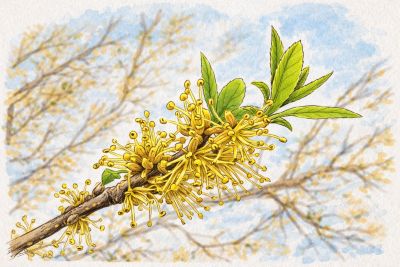
New Mexico Privet,
New Mexico Olive
Desert Olive,
Stretchberry
Elbowbush
Spring Herald
Forestiera pubescens
Olive Family (Oleaceae)
Found in washes, along streams, and in open woodlands
Seen blooming in late March by the Rio Chama
I don’t know what effect this record-breaking heat and drought will have on the flora this season. The trees and shrubs have roots deep in the water table and are already blooming. This New Mexico Privet usually blooms here in mid-April and is blooming in March. It is native and quite common in this area. It is a straggly, multi-stemmed, shrubby tree growing to 15 feet tall with smooth, gray bark and lance-shaped, simple leaves. It can form dense thickets. Large shrubs were considered water indicators because wells dug where plants grew always produced water. The inconspicuous yellow flowers bloom before the leaves. Trees are either male or female, the flowers pictured here are female. The abundant berries are blue-black and are an important food source for wildlife. They are not toxic to humans in small quantities but not considered edible.
To comment, please email me.